
May 31, 2022
BY om shanti : motivational speaker0
Comments
Tuesday, May 31, 2022

Monday, May 30, 2022
Sunday, May 29, 2022
Saturday, May 28, 2022
Friday, May 27, 2022
Thursday, May 26, 2022
Tuesday, May 24, 2022
Monday, May 23, 2022
Friday, May 20, 2022

May 20, 2022
BY om shanti : motivational speaker0
Comments

The Abdul Latif Jameel Water and Food Systems Lab (J-WAFS) at MIT has awarded eight MIT principal investigators with 2022 J-WAFS seed grants. The grants support innovative MIT research that has the potential to have significant impact on water- and food-related challenges.
The only program at MIT that is dedicated to water- and food-related research, J-WAFS has offered seed grant funding to MIT principal investigators and their teams for the past eight years. The grants provide up to $75,000 per year, overhead-free, for two years to support new, early-stage research in areas such as water and food security, safety, supply, and sustainability. Past projects have spanned many diverse disciplines, including engineering, science, technology, and business innovation, as well as social science and economics, architecture, and urban planning.
Seven new projects led by eight researchers will be supported this year. With funding going to four different MIT departments, the projects address a range of challenges by employing advanced materials, technology innovations, and new approaches to resource management. The new projects aim to remove harmful chemicals from water sources, develop drought monitoring systems for farmers, improve management of the shellfish industry, optimize water purification materials, and more.
“Climate change, the pandemic, and most recently the war in Ukraine have exacerbated and put a spotlight on the serious challenges facing global water and food systems,” says J-WAFS director John H. Lienhard. He adds, “The proposals chosen this year have the potential to create measurable, real-world impacts in both the water and food sectors.”
The 2022 J-WAFS seed grant researchers and their projects are:
Gang Chen, the Carl Richard Soderberg Professor of Power Engineering in MIT’s Department of Mechanical Engineering, is using sunlight to desalinate water. The use of solar energy for desalination is not a new idea, particularly solar thermal evaporation methods. However, the solar thermal evaporation process has an overall low efficiency because it relies on breaking hydrogen bonds among individual water molecules, which is very energy-intensive. Chen and his lab recently discovered a photomolecular effect that dramatically lowers the energy required for desalination.
The bonds among water molecules inside a water cluster in liquid water are mostly hydrogen bonds. Chen discovered that a photon with energy larger than the bonding energy between the water cluster and the remaining water liquids can cleave off the water cluster at the water-air interface, colliding with air molecules and disintegrating into 60 or even more individual water molecules. This effect has the potential to significantly boost clean water production via new desalination technology that produces a photomolecular evaporation rate that exceeds pure solar thermal evaporation by at least ten-fold.
John E. Fernández is the director of the MIT Environmental Solutions Initiative (ESI) and a professor in the Department of Architecture, and also affiliated with the Department of Urban Studies and Planning. Fernández is working with Scott D. Odell, a postdoc in the ESI, to better understand the impacts of mining and climate change in water-stressed regions of Chile.
The country of Chile is one of the world’s largest exporters of both agricultural and mineral products; however, little research has been done on climate change effects at the intersection of these two sectors. Fernández and Odell will explore how desalination is being deployed by the mining industry to relieve pressure on continental water supplies in Chile, and with what effect. They will also research how climate change and mining intersect to affect Andean glaciers and agricultural communities dependent upon them. The researchers intend for this work to inform policies to reduce social and environmental harms from mining, desalination, and climate change.
Ariel L. Furst is the Raymond (1921) and Helen St. Laurent Career Development Professor of Chemical Engineering at MIT. Her 2022 J-WAFS seed grant project seeks to effectively remove dangerous and long-lasting chemicals from water supplies and other environmental areas.
Perfluorooctanoic acid (PFOA), a component of Teflon, is a member of a group of chemicals known as per- and polyfluoroalkyl substances (PFAS). These human-made chemicals have been extensively used in consumer products like nonstick cooking pans. Exceptionally high levels of PFOA have been measured in water sources near manufacturing sites, which is problematic as these chemicals do not readily degrade in our bodies or the environment. The majority of humans have detectable levels of PFAS in their blood, which can lead to significant health issues including cancer, liver damage, and thyroid effects, as well as developmental effects in infants. Current remediation methods are limited to inefficient capture and remain limited mostly to a laboratory setting. Furst’s proposed method utilizes low-energy, scaffolded enzyme materials to move beyond simple capture to degrade these hazardous pollutants.
Heather J. Kulik is an associate professor in the Department of Chemical Engineering at MIT who is developing novel computational strategies to identify optimal materials for purifying water. Water treatment requires purification by selectively separating small ions from water. However, human-made, scalable materials for water purification and desalination are often not stable in typical operating conditions and lack precision pores for good separation.
Metal-organic frameworks (MOFs) are promising materials for water purification because their pores can be tailored to have precise shapes and chemical makeup for selective ion affinity. Yet few MOFs have been assessed for their properties relevant to water purification. Kulik plans to use virtual high-throughput screening accelerated by machine learning models and molecular simulation to accelerate discovery of MOFs. Specifically, Kulik will be looking for MOFs with ultra-stable structures in water that do not break down at certain temperatures.
Gregory C. Rutledge is the Lammot du Pont Professor of Chemical Engineering at MIT. He is leading a project that will explore how to better separate oils from water. This is an important problem to solve given that industry-generated oil-contaminated water is a major source of pollution to the environment.
Emulsified oils are particularly challenging to remove from water due to their small droplet sizes and long settling times. Microfiltration is an attractive technology for the removal of emulsified oils, but its major drawback is fouling, or the accumulation of unwanted material on solid surfaces. Rutledge will examine the mechanism of separation behind liquid-infused membranes (LIMs) in which an infused liquid coats the surface and pores of the membrane, preventing fouling. Robustness of the LIM technology for removal of different types of emulsified oils and oil mixtures will be evaluated.
César Terrer is an assistant professor in the Department of Civil and Environmental Engineering whose J-WAFS project seeks to answer the question: How can satellite images be used to provide a high-resolution drought monitoring system for farmers?
Drought is recognized as one of the world’s most pressing issues, with direct impacts on vegetation that threaten water resources and food production globally. However, assessing and monitoring the impact of droughts on vegetation is extremely challenging as plants’ sensitivity to lack of water varies across species and ecosystems. Terrer will leverage a new generation of remote sensing satellites to provide high-resolution assessments of plant water stress at regional to global scales. The aim is to provide a plant drought monitoring product with farmland-specific services for water and socioeconomic management.
Michael Triantafyllou is the Henry L. and Grace Doherty Professor in Ocean Science and Engineering in the Department of Mechanical Engineering. He is developing a web-based system for natural resources management that will deploy geospatial analysis, visualization, and reporting to better manage and facilitate aquaculture data. By providing value to commercial fisheries’ permit holders who employ significant numbers of people and also to recreational shellfish permit holders who contribute to local economies, the project has attracted support from the Massachusetts Division of Marine Fisheries as well as a number of local resource management departments.
Massachusetts shell fisheries generated roughly $339 million in 2020, accounting for 17 percent of U.S. East Coast production. Managing such a large industry is a time-consuming process, given there are thousands of acres of coastal areas grouped within over 800 classified shellfish growing areas. Extreme climate events present additional challenges. Triantafyllou’s research will help efforts to enforce environmental regulations, support habitat restoration efforts, and prevent shellfish-related food safety issues.
from ScienceBlog.com https://ift.tt/zJpM3Ir
via
May 20, 2022
BY om shanti : motivational speaker0
Comments
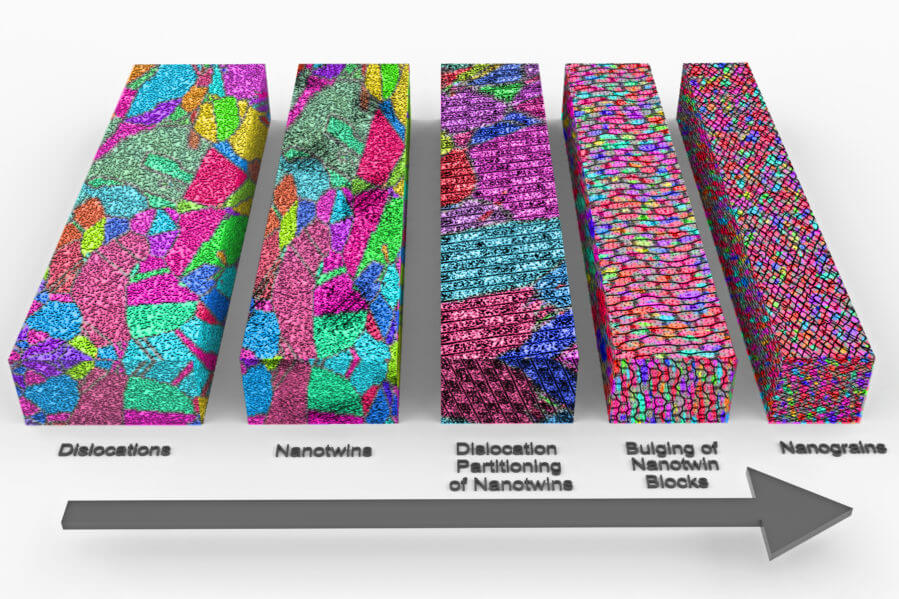
Forming metal into the shapes needed for various purposes can be done in many ways, including casting, machining, rolling, and forging. These processes affect the sizes and shapes of the tiny crystalline grains that make up the bulk metal, whether it be steel, aluminum or other widely used metals and alloys.
Now researchers at MIT have been able to study exactly what happens as these crystal grains form during an extreme deformation process, at the tiniest scales, down to a few nanometers across. The new findings could lead to improved ways of processing to produce better, more consistent properties such as hardness and toughness.
The new findings, made possible by detailed analysis of images from a suite of powerful imaging systems, are reported today in the journal Nature Materials, in a paper by former MIT postdoc Ahmed Tiamiyu (now assistant professor at the University of Calgary); MIT professors Christopher Schuh, Keith Nelson, and James LeBeau; former student Edward Pang; and current student Xi Chen.
“In the process of making a metal, you are endowing it with a certain structure, and that structure will dictate its properties in service,” Schuh says. In general, the smaller the grain size, the stronger the resulting metal. Striving to improve strength and toughness by making the grain sizes smaller “has been an overarching theme in all of metallurgy, in all metals, for the past 80 years,” he says.
Metallurgists have long applied a variety of empirically developed methods for reducing the sizes of the grains in a piece of solid metal, generally by imparting various kinds of strain through deforming it in one way or another. But it’s not easy to make these grains smaller.
The primary method is called recrystallization, in which the metal is deformed and heated. This creates many small defects throughout the piece, which are “highly disordered and all over the place,” says Schuh, who is the Danae and Vasilis Salapatas Professor of Metallurgy.
When the metal is deformed and heated, then all those defects can spontaneously form the nuclei of new crystals. “You go from this messy soup of defects to freshly new nucleated crystals. And because they’re freshly nucleated, they start very small,” leading to a structure with much smaller grains, Schuh explains.
What’s unique about the new work, he says, is determining how this process takes place at very high speed and the smallest scales. Whereas typical metal-forming processes like forging or sheet rolling, may be quite fast, this new analysis looks at processes that are “several orders of magnitude faster,” Schuh says.
“We use a laser to launch metal particles at supersonic speeds. To say it happens in the blink of an eye would be an incredible understatement, because you could do thousands of these in the blink of an eye,” says Schuh.
Such a high-speed process is not just a laboratory curiosity, he says. “There are industrial processes where things do happen at that speed.” These include high-speed machining; high-energy milling of metal powder; and a method called cold spray, for forming coatings. In their experiments, “we’ve tried to understand that recrystallization process under those very extreme rates, and because the rates are so high, no one has really been able to dig in there and look systematically at that process before,” he says.
Using a laser-based system to shoot 10-micrometer particles at a surface, Tiamiyu, who carried out the experiments, “could shoot these particles one at a time, and really measure how fast they are going and how hard they hit,” Schuh says. Shooting the particles at ever-faster speeds, he would then cut them open to see how the grain structure evolved, down to the nanometer scale, using a variety of sophisticated microscopy techniques at the MIT.nano facility, in collaboration with microscopy specialists.
The result was the discovery of what Schuh says is a “novel pathway” by which grains were forming down to the nanometer scale. The new pathway, which they call nano-twinning assisted recrystallization, is a variation of a known phenomenon in metals called twinning, a particular kind of defect in which part of the crystalline structure flips its orientation. It’s a “mirror symmetry flip, and you end up getting these stripey patterns where the metal flips its orientation and flips back again, like a herringbone pattern,” he says. The team found that the higher the rate of these impacts, the more this process took place, leading to ever smaller grains as those nanoscale “twins” broke up into new crystal grains.
In the experiments they did using copper, the process of bombarding the surface with these tiny particles at high speed could increase the metal’s strength about tenfold. “This is not a small change in properties,” Schuh says, and that result is not surprising since it’s an extension of the known effect of hardening that comes from the hammer blows of ordinary forging. “This is sort of a hyper-forging type of phenomenon that we’re talking about.”
In the experiments, they were able to apply a wide range of imaging and measurements to the exact same particles and impact sites, Schuh says: “So, we end up getting a multimodal view. We get different lenses on the same exact region and material, and when you put all that together, you have just a richness of quantitative detail about what’s going on that a single technique alone wouldn’t provide.”
Because the new findings provide guidance about the degree of deformation needed, how fast that deformation takes place, and the temperatures to use for maximum effect for any given specific metals or processing methods, they can be directly applied right away to real-world metals production, Tiamiyu says. The graphs they produced from the experimental work should be generally applicable. “They’re not just hypothetical lines,” Tiamiyu says. For any given metals or alloys, “if you’re trying to determine if nanograins will form, if you have the parameters, just slot it in there” into the formulas they developed, and the results should show what kind of grain structure can be expected from given rates of impact and given temperatures.
The research was supported by the U.S. Department of Energy, the Office of Naval Research, and the Natural Sciences and Engineering Research Council of Canada.
from ScienceBlog.com https://ift.tt/oXbZwgn
via
Thursday, May 19, 2022
Wednesday, May 18, 2022
Tuesday, May 17, 2022
Monday, May 16, 2022
May 16, 2022
BY om shanti : motivational speaker0
Comments
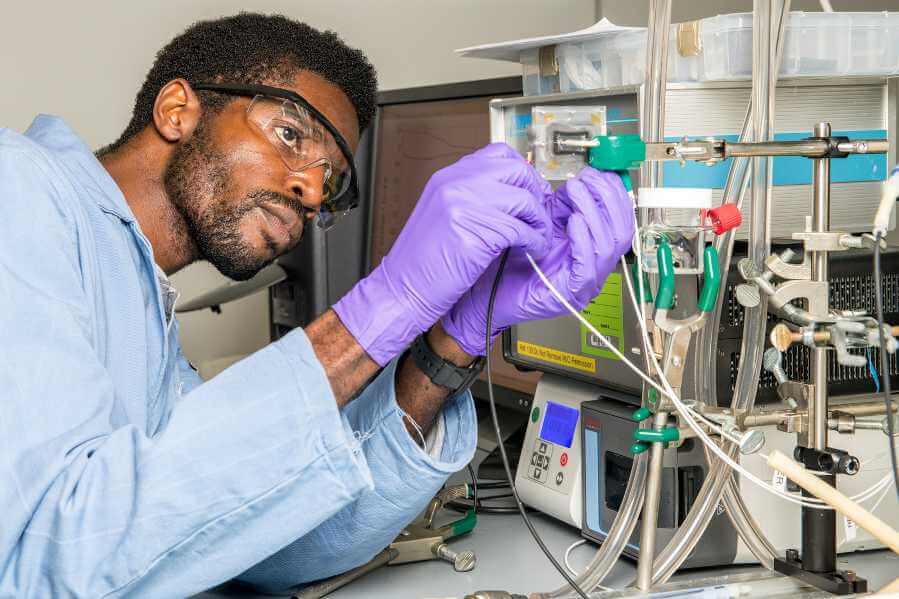
You may be familiar with direct air capture, or DAC, in which carbon dioxide is removed from the atmosphere in an effort to slow the effects of climate change. Now a scientist at Lawrence Berkeley National Laboratory (Berkeley Lab) has proposed a scheme for direct ocean capture. Removing CO2 from the oceans will enable them to continue to do their job of absorbing excess CO2 from the atmosphere.
Experts mostly agree that combating climate change will take more than halting emissions of climate-warming gases. We must also remove the carbon dioxide and other greenhouse gases that have already been emitted, to the tune of gigatons of CO2 removed each year by 2050 in order to achieve net zero emissions. The oceans contain significantly more CO2 than the atmosphere and have been acting as an important carbon sink for our planet.
Peter Agbo is a Berkeley Lab staff scientist in the Chemical Sciences Division, with a secondary appointment in the Molecular Biophysics and Integrated Bioimaging Division. He was awarded a grant through Berkeley Lab’s Carbon Negative Initiative, which is aiming to develop breakthrough negative emissions technologies, for his ocean capture proposal. His co-investigators on this project are Steven Singer at the Joint BioEnergy Institute and Ruchira Chatterjee, a scientist in the Molecular Biophysics and Integrated Bioimaging Division of Berkeley Lab.
Q. Can you explain how you envision your technology to work?
What I’m essentially trying to do is convert CO2 to limestone, and one way to do this is to use seawater. The reason you can do this is because limestone is composed of magnesium, or what’s called magnesium and calcium carbonates. There’s a lot of magnesium and calcium naturally resident in seawater. So if you have free CO2 floating around in seawater, along with that magnesium and calcium, it will naturally form limestone to a certain extent, but the process is very slow – borderline geologic time scales.
It turns out that the bottleneck in the conversion of CO2 to these magnesium and calcium carbonates in seawater is a process that is naturally catalyzed by an enzyme called carbonic anhydrase. It’s not important to know the enzyme name; it’s just important to know that when you add carbonic anhydrase to this seawater mixture, you can basically accelerate the conversion of CO2 to these limestones under suitable conditions.
And so the idea is to scale this up – drawing CO2 out of the atmosphere into the ocean and ultimately into some limestone product that you could sequester.
Q. Fascinating. So you want to turn carbon dioxide into rock using a process that occurs naturally in seawater, but accelerating it. This sounds almost like science fiction. What are the challenges in getting this to work?
To absorb CO2 from the air quick enough for the technology to work, you have to solve the problem of how to provide enough of this enzyme that you could deploy this process at a meaningful scale. If we were to simply try to supply the enzyme as a pure product, you couldn’t do it in an economically viable way. So the question I’m trying to answer here is, how would you do this? You also have to find ways of stabilizing the pH and mixing in enough air to raise and maintain your CO2 concentration in water.
The solution that occurred to me was, okay, given that we know carbonic anhydrase is a protein, and proteins are naturally synthesized by biochemical systems, such as bacteria, which we can manipulate, then we could take bacteria and then engineer them to make carbonic anhydrase for us. And you can just keep growing these bacteria as long as you feed them. One problem, though, is that now you’ve shifted the cost burden onto supplying enough food to produce enough bacteria to produce enough enzyme.
One way around this issue would be to use bacteria that can grow using energy and nutrients that are readily available in the natural environment. So this pointed towards photosynthetic bacteria. They can use sunlight as their energy source, and they can also use CO2 as their carbon source to feed on. And certain photosynthetic bacteria can also use the minerals that naturally occur in seawater essentially as vitamins.
Q. Interesting. So the path to capturing excess CO2 lays in being able to engineer a microbe?
Potentially one way, yes. What I’ve been working on in this project is to develop a genetically modified bacterium that is photosynthetic and is engineered to produce a lot of carbon anhydrase on its surface. Then, if you were to put it in seawater, where you have a lot of magnesium and calcium, and also CO2 present, you would see a rapid formation of limestone. That’s the basic idea.
It’s a small project for now, so I decided to focus on getting the engineered organism. Right now, I’m simply trying to develop the primary catalyst system, which are the enzyme-modified bacteria to drive the mineralization. The other non-trivial pieces of this approach – how to appropriately design the reactor to stabilize CO2 concentrations and pH needed for this scheme to work – are future challenges. But I’ve been using simulations to inform my approaches to those problems.
It’s a fun project because on any given day my co-PIs and I could be doing either physical electrochemistry or gene manipulation in the lab.
Q. How would this look once it’s scaled up? And how much carbon would it be able to sequester?
What I have envisioned is, the bacterium would be grown in a plant-scaled bioreactor. You basically flow seawater into this bioreactor while actively mixing in air, and it processes the seawater, converting it to limestone. Ideally, you probably have some type of downstream centrifugation process to extract the solids, which maybe could be driven by the flow of water itself, which then helps to pull out the limestone carbonates before you then eject the depleted seawater. An alternative that could possibly resolve the pH constraints of mineralization would be to implement this instead as a reversible process, where you also use the enzyme to reconvert the carbon you’ve captured in seawater back to a more concentrated CO2 stream (carbonic anhydrase behavior is reversible).
What I’ve calculated for this system, assuming that the protein carbonic anhydrase behaves on the bacterial surface, more or less, the way it does in free solution, would suggest that you would need a plant that has only about a 1-million-liter volume, which is actually quite small. One of those could get you to roughly 1 megaton of CO2 captured per year. A lot of assumptions are built into that sort of estimate though, and it’s likely to change as work advances.
Erecting 1,000 such facilities globally, which is a small number compared to the 14,000 water treatment facilities in the United States alone, would permit the annual, gigaton-scale capture of atmospheric CO2.
from ScienceBlog.com https://ift.tt/2IcJgqL
via
Friday, May 13, 2022
Wednesday, May 11, 2022
Tuesday, May 10, 2022
Monday, May 9, 2022
Friday, May 6, 2022
Thursday, May 5, 2022
Wednesday, May 4, 2022

May 04, 2022
BY om shanti : motivational speaker0
Comments

The flashing of a nearby star has drawn MIT astronomers to a new and mysterious system 3,000 light years from Earth. The stellar oddity appears to be a new “black widow binary” — a rapidly spinning neutron star, or pulsar, that is circling and slowly consuming a smaller companion star, as its arachnid namesake does to its mate.
Astronomers know of about two dozen black widow binaries in the Milky Way. This newest candidate, named ZTF J1406+1222, has the shortest orbital period yet identified, with the pulsar and companion star circling each other every 62 minutes. The system is unique in that it appears to host a third, far-flung star that orbits around the two inner stars every 10,000 years.
This likely triple black widow is raising questions about how such a system could have formed. Based on its observations, the MIT team proposes an origin story: As with most black widow binaries, the triple system likely arose from a dense constellation of old stars known as a globular cluster. This particular cluster may have drifted into the Milky Way’s center, where the gravity of the central black hole was enough to pull the cluster apart while leaving the triple black widow intact.
“It’s a complicated birth scenario,” says Kevin Burdge, a Pappalardo Postdoctoral Fellow in MIT’s Department of Physics. “This system has probably been floating around in the Milky Way for longer than the sun has been around.”
Burdge is the author of a study appearing today in Nature that details the team’s discovery. The researchers used a new approach to detect the triple system. While most black widow binaries are found through the gamma and X-ray radiation emitted by the central pulsar, the team used visible light, and specifically the flashing from the binary’s companion star, to detect ZTF J1406+1222.
“This system is really unique as far as black widows go, because we found it with visible light, and because of its wide companion, and the fact it came from the galactic center,” Burdge says. “There’s still a lot we don’t understand about it. But we have a new way of looking for these systems in the sky.”
The study’s co-authors are collaborators from multiple institutions, including the University of Warwick, Caltech, the University of Washington, McGill University, and the University of Maryland.
Day and night
Black widow binaries are powered by pulsars — rapidly spinning neutron stars that are the collapsed cores of massive stars. Pulsars have a dizzying rotational period, spinning around every few milliseconds, and emitting flashes of high-energy gamma and X-rays in the process.
Normally, pulsars spin down and die quickly as they burn off a huge amount of energy. But every so often, a passing star can give a pulsar new life. As a star nears, the pulsar’s gravity pulls material off the star, which provides new energy to spin the pulsar back up. The “recycled” pulsar then starts reradiating energy that further strips the star, and eventually destroys it.
“These systems are called black widows because of how the pulsar sort of consumes the thing that recycled it, just as the spider eats its mate,” Burdge says.
Every black widow binary to date has been detected through gamma and X-ray flashes from the pulsar. In a first, Burdge came upon ZTF J1406+1222 through the optical flashing of the companion star.
It turns out that the companion star’s day side — the side perpetually facing the pulsar — can be many times hotter than its night side, due to the constant high-energy radiation it receives from the pulsar.
“I thought, instead of looking directly for the pulsar, try looking for the star that it’s cooking,” Burdge explains.
He reasoned that if astronomers observed a star whose brightness was changing periodically by a huge amount, it would be a strong signal that it was in a binary with a pulsar.
Star motion
To test this theory, Burdge and his colleagues looked through optical data taken by the Zwicky Transient Facility, an observatory based in California that takes wide-field images of the night sky. The team studied the brightness of stars to see whether any were changing dramatically by a factor of 10 or more, on a timescale of about an hour or less — signs that indicate the presence of a companion star orbiting tightly around a pulsar.
The team was able to pick out the dozen known black widow binaries, validating the new method’s accuracy. They then spotted a star whose brightness changed by a factor of 13, every 62 minutes, indicating that it was likely part of a new black widow binary, which they labeled ZTF J1406+1222.
They looked up the star in observations taken by Gaia, a space telescope operated by the European Space Agency that keeps precise measurements of the position and motion of stars in the sky. Looking back through decades old measurements of the star from the Sloan Digital Sky Survey, the team found that the binary was being trailed by another distant star. Judging from their calculations, this third star appeared to be orbiting the inner binary every 10,000 years.
Curiously, the astronomers have not directly detected gamma or X-ray emissions from the pulsar in the binary, which is the typical way in which black widows are confirmed. ZTF J1406+1222, therefore, is considered a candidate black widow binary, which the team hopes to confirm with future observations.
“The one thing we know for sure is that we see a star with a day side that’s much hotter than the night side, orbiting around something every 62 minutes,” Burdge says. “Everything seems to point to it being a black widow binary. But there are a few weird things about it, so it’s possible it’s something entirely new.”
The team plans to continue observing the new system, as well as apply the optical technique to illuminate more neutron stars and black widows in the sky.
This research was supported, in part, by the National Science Foundation.
from ScienceBlog.com https://ift.tt/yMO0VFE
via
Tuesday, May 3, 2022
May 03, 2022
BY om shanti : motivational speaker0
Comments
The mRNA vaccines for COVID are doubly flawed. One problem in particular must have been known to the biochemists and the other to the leadership who choose to rely on these vaccines. The first problem is that the dose is uncontrolled; different people produce vastly different amounts of the spike protein from the same injection. The second is that the spike protein itself is the part of the virus that does damage to the human system. Any other part of the virus might have been a better choice for the target presented to the body to stimulate an immune response. Obviously, these problems are worse together than either separately.
Traditional vaccines use a whole, weakened virus or a chemical piece of the virus to give the body a headstart making an immune response to a pathogen that may be coming in the future. The mRNA vaccines from Pfizer and Moderna (but not the adenovirus vaccine from J&J) are based on a clever variation. Instead of delivering a protein from the virus, the vaccines deliver mRNA instructions for making this protein.
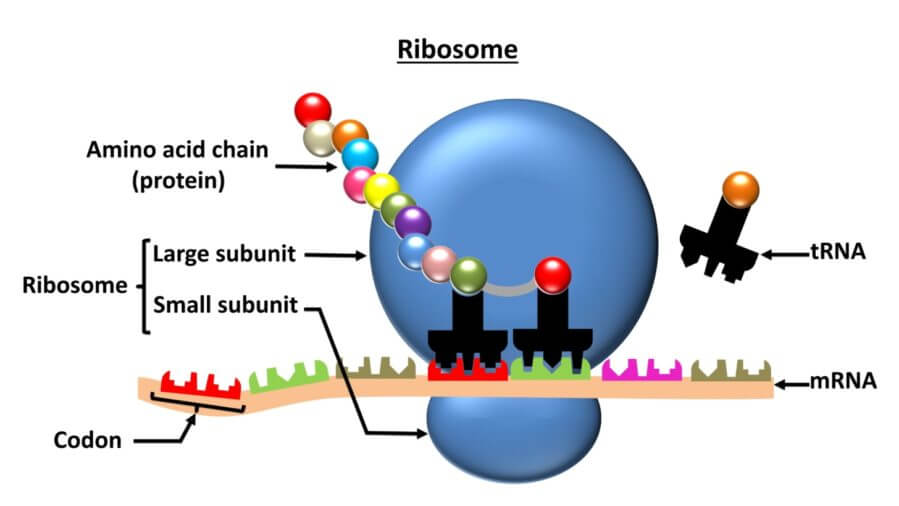
Every cell in our bodies* (and almost every plant and animal cell) has a nucleus with DNA and ribosomes for manufacturing proteins. The DNA doesn’t have chemical activity of its own, but acts as an information repository. Epigenetic chemical markers point to segments of the DNA that are to be activated. Activation starts with the DNA opening up and a a portion being copied into messenger RNA (mRNA). The mRNA then leaves the nucleus and goes out into the cell looking for a ribosome. The ribosome picks up the mRNA template and reads it, 3 bases at a time, translating the message into instructions for creating a protein. Then the mRNA is degraded so its parts can be recycled.
The mRNA vaccines contain instructions for making the spike protein from the SARS-CoV-2 virus associated with COVID. It is housed in a lipid nanoparticle = a tiny bubble of oil that allows it to pass through the cell membrane. (Normally the cell membrane would exclude any naked RNA molecule.) The vaccine mRNA is modified in several ways that make it both more efficient at producing the protein and also resistant to degradation afterward, so it can be used as a template many times.
This is a clever idea, and useful to the manufacturers because there are computer-controlled techniques for generating any desired strand of RNA, whereas manufacturing proteins is much more expensive, and growing viruses (even more so) requires bioreactors and not just chemical reactors. For these reasons, mRNA is a financially attractive experimental platform. But some preliminary research steps are necessary. Does the body respond to a “foreign” protein that is generated in its own cells in the same way that it responds to a wholly foreign invader? We don’t understand the immune system well enough to answer this question theoretically. Experiments to discover the answer were conducted beginning almost 30 years ago, and the results were characterized by the experimenters themselves as promising but not ready for prime time [review, history]
Before 2020, the only human trials were with cancer patients who served as willing subjects because they were already in a life-threatening situation. In desperate circumstances, larger risks of side effects may be justifiable. A vaccine delivered to billions of healthy people should be held to a tighter standard. It’s one thing to maim one in a thousand experimental subjects who are facing no better choices in a battle with cancer; it’s another thing entirely to maim millions of healthy people because billions have taken a vaccine which they were told was “safe and effective”. “Immunization of healthy individuals requires safety standards far beyond those applicable for therapeutic approaches.” [Roesler et al]
First flaw
One problem is that some cells allow the nanoparticles entry, while others don’t. Some people’s bodies see past the trick and degrade the mRNA in short order, while in other bodies, the mRNA lingers for months. In some people, the mRNA remains confined in the shoulder muscle, while in others it finds its way into the bloodstream and distributes to genital organs, liver, heart, and brain.
Normally, DNA translation into mRNA is a one-way street. But there are exceptions. Retroviruses like SARS and HIV rely on reverse transcriptase to make DNA copies of themselves. Retroviruses can insinuate themselves permanently into the host genome. It is known that reverse transcriptase can be found in the healthy human body, maybe as a result of some dormant virus, or perhaps it is part of our normal metabolism. In any case, we now know that the mRNA from a vaccine can sometimes be translated backward into DNA, where it becomes a permanent part of the genome [in vitro, in vivo, blog article]. It can go on generating more mRNA and more spike protein for life. If the reverse transcription occurs in a cell in the ovaries or testes, the DNA may be altered for future generations.
Controlling the dosage is an important part of vaccine science. We need enough to stimulate an immune response, but not too much to make us sick. An overactive immune response can lead to antibody-dependent enhancement (ADE) when the patient is exposed later to the disease itself. ADE creates a cytokine storm with the possibility of fatal complications. A big problem with dosage is inherent with the mRNA vaccine technology. It is not the dosage of the mRNA that is important, but dosage of the protein it creates, and this varies widely from person to person.
Second flaw
For most viruses, the spike protein is simply a way to bind to the cell and knock on the door of the cell membrane, seeking admission into the cell. It is optimized by evolution for binding to the cell. But the spike protein of the SARS-CoV-2 virus is biologically active in the human body, and its activity is toxic in several ways. This was first reported in the summer of 2020, and in the fall (just as vaccines were being tested), the issue was publicized in the research community. Dr John Patrick Whelan of UCLA submitted documentation to the FDA warning that the spike protein could cause blood clots and could enter the brain. He raised the possibility that the spike protein itself was responsible for the fatality rate of COVID-19. The spike protein causes blood clots and can damage the walls of arteries. It can cross the blood-brain barrier and cause neural damage in the brain.
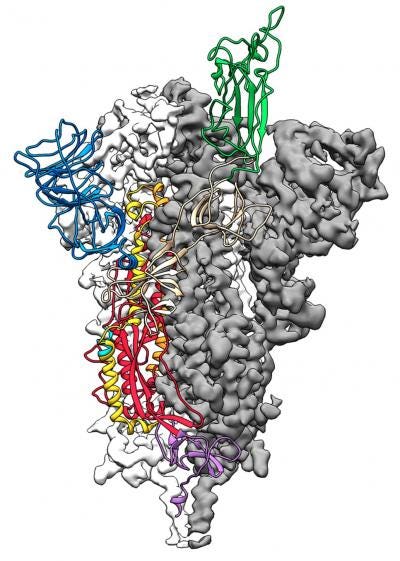
Viruses evolve in a way to maximize their reproduction and their spread from one person to another. The virus has no interest in making you sick, though it might want you to sneeze in order to spread virus particles in the air. When people feel sick from a virus, it is because the virus is replicating rapidly and, hogging the body’s resources; it is not an adaptation of the virus to make you sick. A toxic spike protein is not helpful to the virus. Toxicity of the spike protein is one reason that tips off scientists: this virus looks as though it was engineered for its damage potential in a bioweapons laboratory. Natural evolution would not likely produce a spike protein that is so toxic.
In principle, any part of the virus can be used as an epitope (tag) that warns the immune system what is coming. But all the mainstream vaccines, including the adenovirus vaccine of J&J, use the spike protein as epitope. The epitope was selected early in the design phase of the vaccines, in the winter of 2020.
SPECULATION
We cannot know whether this choice was malicious on the part of some of the people involved. In March of 2020, Dr Fauci (according to FOIAd emails) commissioned a Nature Medicine article to put to bed rumors that COVID had originated in a laboratory. The article was long on rhetoric and contained just one relevant fact: that the virus’s spike protein was not optimized for binding with the human ACE-2 receptor. The article claimed that surely, surely any engineers who were creating an artificial spike protein via genetic engineering would have been motivated to design the spike protein for a perfect fit with human ACE-2. In retrospect, we might ask, how did the authors of the paper (or Fauci himself) know this? And was it a Freudian admission, what Edgar Allan Poe would have called the Imp of the Perverse. In my mind, this incident raises the suspicion that Fauci knew early on that the spike protein had been genetically modified to have other functions than just entry into a cell, and those functions were explicitly pathogenic.
Indeed, we now know that the spike protein causes blood clots, damages the epithelium of arteries, interferes with pregnancy, can suppress the immune system generally, and crosses the blood-brain barrier to create prion-like tangles in the brain.
By December of 2020, the vaccine manufacturers and FDA certainly knew that the spike protein was going to cause problems for vaccinated patients, because Dr Whelan had laid out the evidence in front of them. The generous interpretation of their behavior is that they were dug in too deeply and, for political reasons, could not afford a delay in re-engineering a vaccine based on a different epitope. A less generous interpretation would impute intent to harm.
Synergy
These two problems together are worse than the sum of the parts. Obviously, producing excessive quantities of the spike protein and continuing to generate the spike protein months after vaccination become a much more serious health hazard when we realize how toxic the spike protein is.
————
*Red blood cells are an exception. They have no nucleus.
from ScienceBlog.com https://ift.tt/XlnCOmJ
via
Monday, May 2, 2022

May 02, 2022
BY om shanti : motivational speaker0
Comments
When it comes to waste (and the disposal thereof), it’s a, figuratively speaking, jungle out there. And, it’s seemingly everywhere: It’s in outer space and in the seas. It’s in the air (in the form of air pollution), produced by living, breathing beings (nasal discharge, earwax, in the context also of evacuated or excreted bodily solids, to name several) and it also comes as a result of a seemingly endless array of production and/or consumption activities. And, there, apparently, is nowhere on the face of the earth that is untouched in some way, shape or form by the stuff, hence the “it’s seemingly everywhere” reference above.
So being there is so much of it, so much waste, that is, and being that a considerable amount of said waste directly or indirectly affects the air we breathe, what better opportunity is there than during Air Quality Awareness Week, this year being observed May 2 through May 6, to draw attention to and focus attention on this thorny issue.
Waste’s two sides: The production and processing of
The production of waste is the easy aspect. Far less so is the waste-processing element. It’s always been this way and it probably always will be.
Good waste and bad
There is both good and bad waste. The bad type cannot be readily disposed of. The bulk of it goes to the waste heap, otherwise known as the landfill. Some of it, depending on content, substance, must be handled extremely carefully or delicately, as would be the case with nuclear power-plant waste. If the waste is of a type that can be repurposed, reused, renewed or recycled, then by all means, it should be designated for and directed to one of these four processes for further handling provided the provisions for doing such exists. Would that it could, that’s the kind of waste that’s good.
Okay, so now that some of waste’s fundamentals have been covered, the list below, which, by the way, is by no means meant to be exhaustive, does, on the other hand, include several of the more popular methods of controlling, eliminating, reducing waste.
Xeriscaping
Not every homeowner wants nor has a need for a green-grass lawn. Xeriscaping is a process by which the yard is landscaped in a manner that enables soils to remain in place by not eroding, but also allows for pleasing aesthetics incorporating elements like walkways (concrete, decomposed granite, flagstone, paver or otherwise), strategically located appropriate vegetation (ground covers, shrubs and trees), accent features like pebbles (pea gravel), river rocks or boulders as well as items such as outdoor lighting (solar operated, preferably) which, all of it taken together, can do much and go far to not only reduce the amount of waste a typical yard incorporating a green-grass lawn can generate, but in some cases, outright eliminate, waste. Xeriscapes can be just what the doctor ordered for new dwelling-unit yard space as well as used as a suitable substitute for an existing lawn or for lawns already in place.
Through xeriscaping, think of all of the container-loads of grass clippings that can be eliminated, not needing to be sent to the municipal dump, that, and all of the money potentially saved from not having to spend on lawn care equipment like mowers, blowers, edgers and trimmers, and, in addition, in eliminating the need to purchase fuel for said equipment whether it be gasoline or electricity. Xeriscaping the grounds can be an excellent alternative.
Haste makes waste
In our oftentimes hurried lives and being that many of us are pressed for time, on many an occasion corners get cut. That can be a problem because waste can result.
Perhaps there is no better example of this than the one of unnecessary motor-vehicle idling taking place in none other than the fast-food, drive-thru line. Not only in this way does gasoline get burned, air becomes polluted and the money spent on such figuratively goes up in smoke, but many times results in long queues of vehicles with passengers waiting in lines, engines continuously running, and, depending on weather conditions present, necessitating the use of interior heating or air conditioning, which can lead to more fuel being wasted.
In situations such as these, drivers (and passengers) might do well to park the car, turn off the ignition switch, exit the vehicle and walk inside the fast-food eating establishment. In some cases, by doing so, the entire ordering process and the time to purchase the food items could very well be less than the time it takes to do the very same thing by waiting in drive-thru lines.
Special curbside refuse-collection events
Fresno, California has in place what is known as “Operation Cleanup.” The service is offered to households (families or individuals) residing within city limits.
The good thing about this once-a-year special refuse-collection service is that it gives households the opportunity to get rid of discards that do not otherwise qualify for gray (regular trash), blue (recyclables) or green (compostables) bin pickup. There are limits, however, on what can be thrown away having to do with amount, type and size of material to be dispensed with. Large tree stumps or tree trunks and chemicals like pesticides, for example, do not qualify. Special arrangements need to be made regarding disposal of these specific items.
Some items piled up at the curbside, as a matter of fact, never even get picked up by city employees assigned to do the pickup activity on account of this being taken by drivers driving around neighborhoods where said discards have been placed by participating residents. If the so-called spotters spot an item or two or three that they believe is of value to them, they will then help themselves to that item or items. One person’s trash is another person’s treasure? In instances such as these, such would seem to be the case.
Honorable mentions
A few of my all-time favorites:
1. Ambient air-dried laundry. Instead of using the automatic clothes dryer for drying laundry, hanging freshly washed laundry on racks made for such placed around the inside of the home, allows the laundry to dry in the ambient air. Turning on the ceiling fan can help speed up the drying process. If wrinkles are a concern, I find that this tends to not be an issue by drying in the dryer for several minutes only the laundry in question, that is, prior to being ambient-air dried.
2. Cloth versus paper napkin use. I prefer to use a cloth napkin as opposed to paper ones at the dining table. The cotton versions can be washed, dried (see number 1. above) and reused, whereas the paper equivalents that are used in lieu of are, for all intents and purposes, made for one-time use.
3. Light-sensing street lighting. The street lighting that uses light sensors to activate and deactivate said street lights, can both save on electricity use and extend light or lamp life. And, the less utility-supplied electricity consumed by such, the less opportunity there is for air pollution to be released into the atmosphere.
Working together
If each of us were a tad more mindful and wasted less – even if just a little less – both the air and the earth would invariably be in better shape. This is something every one would benefit from by doing, whether on Earh Day (Apr. 22), during Air Quality Awareness Week or all year long.
– Alan Kandel
Copyrighted material.
from ScienceBlog.com https://ift.tt/mpTHlDA
via

.png)